2025 Award Winners


Carlo Albano | Administrator Awardee
Santa Cruz Gardens Elementary, Santa Cruz, CA
The California Environmental Education Foundation (CEEF) is thrilled to award the 2025 Excellence in Environmental Education Award in the Administrator category to Carlo Albano, Principal of Santa Cruz Gardens Elementary School. Principal Albano champions the Science and Gardening Emphasis (SAGE) Program at Santa Cruz Gardens. The program is an integrated approach to public education that guides students toward a deeper relationship with the natural world. The learning experiences are rooted in the Next Generation Science Standards (NGSS), and students develop both an understanding of the interconnectedness of ecosystems, and compassion to serve as stewards of the natural world.
Principal Albano developed his affinity for nature growing up in Milwaukee, the son of a marine scientist/reef warden and a landscape architect. Milwaukee boasted a strong Preserve our Parks program where Carlo first learned about the “Lungs of the City” and how that leads to healthy people. Carlo had access to parks and local bodies of water and developed a strong belief in outdoor spaces; he sees them as ”place(s) of solace and rejuvenation”. After this upbringing, working in Santa Cruz – with its abundance of outdoor spaces, environmental awareness and sense of stewardship – was amazing.
Principal Albano believes that learning outside the four walls of a classroom is central to a happy and healthy learning environment. SCG was endowed to science based environmental education school (www.scg.suesd.org).
The school tagline of “Here We Grow” leads to many opportunities for student agency; the students have played a leading role in designing, building and learning in permanent outdoor learning spaces. The SAGE Garden located at the front of the school, once underutilized space, is now a nearly, 4,000 sq.ft. multizonal learning environment where students can take a mindful walk through the sensory zone, learn more about specific adaptations in the native and drought tolerant zones or sit with friends on the student designed and built Buddy Bench.
There is a broad range of environmental activities including a Poetry Trail, created by second grade students, offering a rotating outdoor publication venue; efforts related to trail maintenance; projects studying pollinators and creating bee hotels; as well as the formation of student green teams.
Principal Albano supports his highly trained educators who integrate NGSS into all subject matter through hands-on real-world problem solving based on Project Based Learning and Nature Journaling learning models. The teaching team are always on the lookout for local current events that will create teachable moments. Modeling these practices in front of their students also allows space to unpack how scientists and engineers think.
Principal Albano tirelessly advocates for his students and staff, writing grants, requesting donations, and speaking at conferences to garner support of these amazing programs. Principal Albano’s school team has developed strong partnerships with community parents, and non-profit organizations such as Ocean Guardian School (through NOAA). It is truly an impressive program that he has helped shape with his team and with the support of the district and county.
Jeff Rivero | Educator Awardee
Yosemite High School, Watsonsville, CA
Jeff Rivero, a passionate educator at Yosemite High School in Merced, California, is this year’s CEEF educator of the year award winner. With a focus on hands-on, action-oriented learning, Jeff has earned recognition for his important work in both environmental advocacy and social justice. Through initiatives like lithium battery recycling, the creation of a documentary showcasing women's empowerment in Kenya, and the advocacy for healthier oceans, Jeff is showing his students that they have the power to change the world. He teaches students that they have a special power, which he calls their Kid Kryptonite, which is that adults will generally listen to youth when they engage constructively with issues they are passionate about. Together, Jeff and his students have taken on a breadth of issues that improve their local and global environment. CEEF is proud to honor Jeff with this environmental education award.


At Yosemite High School, a continuation school where many students face personal and academic challenges, Jeff’s unique approach to teaching empowers the diverse student body to become environmental advocates and leaders. In his teaching, Jeff blends history, social justice, and environmental stewardship. His students analyze historical events through an environmental lens, exploring how past decisions related to resource management and environmental policies might have impacted societies. This interdisciplinary approach sparks critical thinking and fosters a deep understanding of the interconnectedness of global challenges. Jeff runs the Junior Ambassadors/Interact (JAs) club. The club started a recycling program for lithium batteries. His students dive deep into the environmental consequences of lithium mining, pollution, and resource depletion, and learn the importance of responsible recycling. This project not only reduces ecological harm but also fosters a culture of sustainability and environmental stewardship. Through their work advocating for healthier oceans, Jeff and his students are working on NOAA’s Ocean Guardian status, expanding their commitment to environmental responsibility.
One of the most powerful examples of Jeff's influence as an educator is the student-driven documentary, Girls Can WISH: Women of Int in egrity, Strength, and Hope. This documentary, being written and produced by his students, follows the journey of a female student at the Daraja Academy in Kenya who overcomes immense gender inequality to achieve higher education. His Interact students received a full-ride sponsorship from their sponsoring Rotary Club, Merced Sunrise. The documentary also highlights the intersection of environmental justice and social justice, as these young women strive for equality while advocating for sustainability. Jeff has guided his students through this project, creating a platform that amplifies the voices of those advocating for change on a global scale. The film has already garnered significant support, and the students look forward to entering it in film festivals after its production, making it an invaluable educational tool and an advocacy platform. Jeff’s students engage with global issues and become empowered to raise the bar for addressing international, national, and local concerns.
Jeff’s passion for agriculture stems from his father’s and grandfather’s backgrounds in sweet potato farming and dairy work. Merced County produces over 80% of California’s sweet potato crop, making the state the second-largest producer in the nation, and Jeff believes that connecting smaller farms to green and STEM-related technologies is vital for their survival in a competitive market. He advocates for giving all students, including those in urban areas, the opportunity to explore agricultural STEM, as they might develop innovations that help small farms thrive. Through this, students will also create a deeper respect for the work and dedication required to produce food crops. Jeff’s goal is to support policies that promote sustainable STEM education and regenerative agriculture, helping to sustain the Central Valley as the breadbasket of the world.
Outside of the classroom, Jeff has dedicated himself to promoting environmentally aware legislation. Through his self-funded advocacy trips to Washington, DC, he has championed such programs as Green Ribbon Schools, which is awarded to K–12 schools, school districts, and County Offices of Education that demonstrate exemplary achievement in three key areas: resource efficiency, health and wellness, and environmental and sustainability education. By meeting with lawmakers, senators, and policy advisors, Jeff not only influences policy but also demonstrates to his students the power of civic engagement. “Students today have the power to make a difference, and I want them to see they can use that power to bring about change,” says Jeff.
Perhaps the most profound impact Jeff has had is on his students’ sense of purpose and direction. “I see myself as a coach,” says Jeff. “I want my students to be the quarterbacks of their own future, directing their path with confidence and passion.” Through his mentorship, Jeff ensures that his students are not only academically successful but also equipped with the leadership skills needed to take on environmental and social justice issues in the real world. His students that commit to over 50 hours of after-school lab work consistently achieve a 100% graduation rate — a remarkable feat for a continuation school.
Jeff’s work has earned widespread recognition, including his involvement with the California Environmental Literacy Initiative and his mentorship of youth leaders in the California Youth Climate Policy Leadership Program. Through his work, Jeff Rivero is helping to shape the next generation of environmental leaders. His visionary approach not only educates students about pressing global issues but also empowers them to take action. Jeff’s work reminds us that when we connect students’ passions to the pressing issues of our time, we ignite their potential to create real and lasting change.
Owen Light | Student Awardee
San Diego School of Creative and Performing Arts, San Diego, CA
A love of plants has always been a part of Owen’s life, a passion nurtured by his family. In fact, it was a prolific spider plant at his great-grandfather’s house that inspired the creation of Planting Smiles. Already aware that many students don’t have access to environmental education and that subjects like climate change often aren’t even taught before 11th grade, seeing all those spider plant “babies” sparked an idea that if more kids had a chance to grow and learn about their own plant, it might encourage deeper connections to the natural world and a broader environmental awareness for youth in general. With his family’s help, Owen collected the spider plant’s many offshoots into a suitcase for the trip home, converted their backyard shed into a greenhouse, and with friends began propagating hundreds of plant starts to give away to kids, being thoughtful to only grow plant varieties that would be easy for elementary students to care for on their own.
Karen Taylor | Non-Formal Educator
Ground Education, Long Beach, CA
Karen is the co-founder and co-director of Ground Education which brings nature spaces and high-quality garden-learning to 15,000 students in 30 Long Beach public elementary schools. The goal of Ground Education is to build, nurture, and activate school gardens to increase access to nature and healthy food, support mental health, and make learning fun. Karen ensures that every student gets to dig in the dirt, taste the products of their hard work, and make important connections to classroom concepts.
Since 2008 Karen has developed a robust curriculum, starting at the pre-K level, that is carefully aligned to California’s Next Generation Science Standards and State frameworks. Karen’s family background is in farming which nurtured her love of the outdoors, and combined with her degree in zoology, she collaboratively developed an Eco–STEAM Garden learning approach that guides the teaching services of 25 part-time educators at Ground Education.
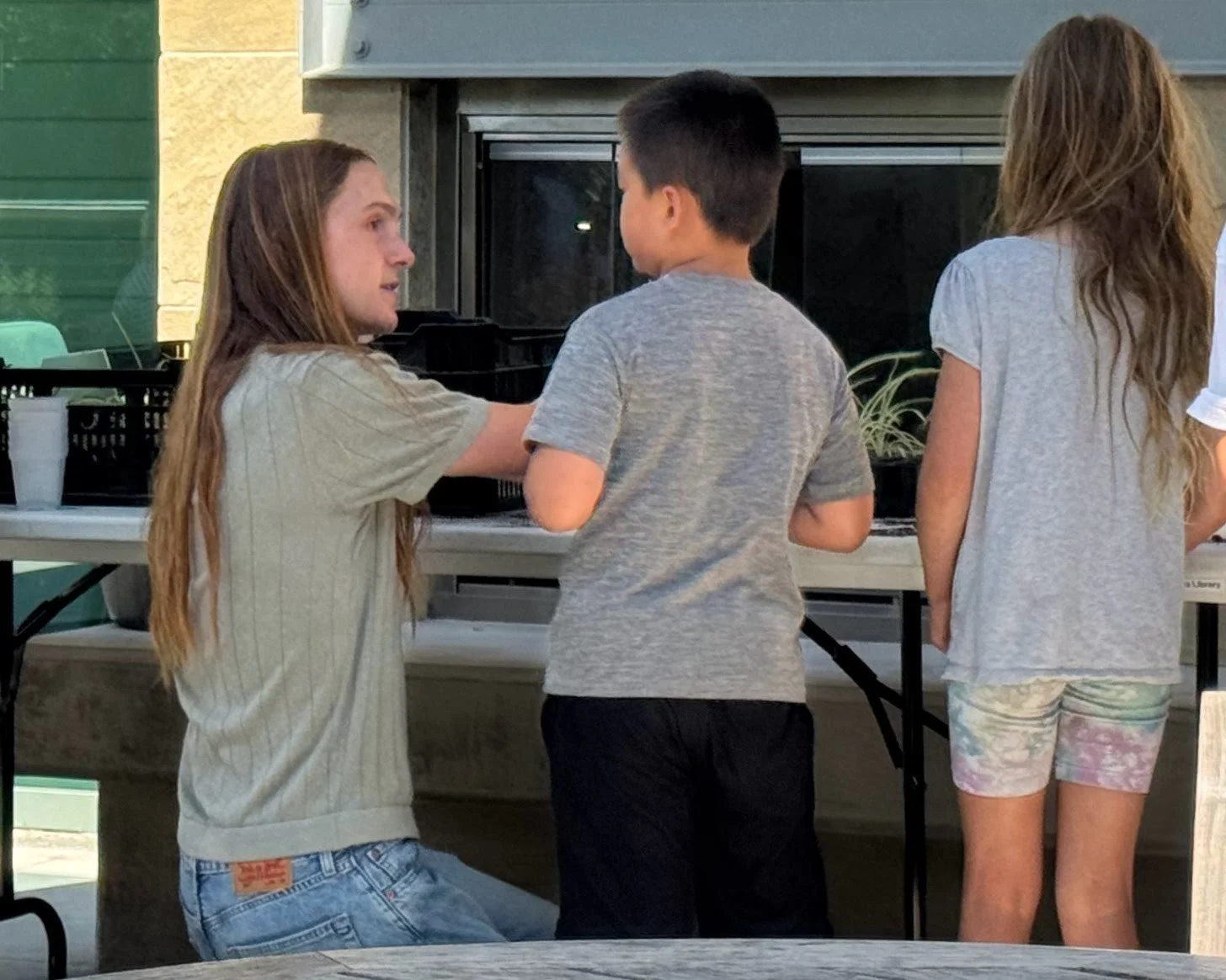
Owen then worked with his AP Environmental Science teacher Rebecca Babbey at San Diego School of Creative and Performing Arts to develop an age-appropriate curriculum and reached out to the principal of Penn Elementary, a nearby Title 1 school, to propose his idea and plan for working with classes across their campus. In December of 2024, Owen delivered plants and lessons to 387 students across 16 classrooms at Penn School! Nervous at first, Owen discovered that he loves working with students and how they light up with excitement when they see him arriving with a boxful of plants. He appreciates their many thoughtful questions and how quickly they pick up concepts and incorporate new vocabulary into their conversations.
School staff have reported how much joy this project has brought to their students and shared letters with him that students have written about their plants. The feedback Owen received has validated his instincts that connecting kids with plants is powerful and meaningful, and he is eager to expand this project.
In preparation for the upcoming school year, Owen continues to propagate plants and experiment with different species and techniques to find how best to scale-up this project for the future. In addition to reaching out to new schools, Owen also plans to offer the Planting Smiles program to other organizations such as the Boys and Girls Clubs and local libraries. To build awareness and solicit plant or financial donations for Planting Smiles, Owen has created a website and is also working on opportunities for volunteers to help with propagation and eventually even program delivery. Owen is committed to growing Planting Smiles and is truly invested in increasing environmental education for youth who often miss out on other outdoor learning opportunities. As a high school senior, there are many demands on Owen’s time. It speaks volumes that among his many responsibilities he continues to mobilize his peer community and connect with local plant groups to sustain and grow this wonderful program. Owen’s project exemplifies the values of building empathy for the natural world through direct personal contact and creating equitable environmental learning opportunities. As members of the CEEF board we are honored to celebrate his achievement, and are grateful for his passion, innovation, and commitment to connecting young people to the natural world one plant at a time.
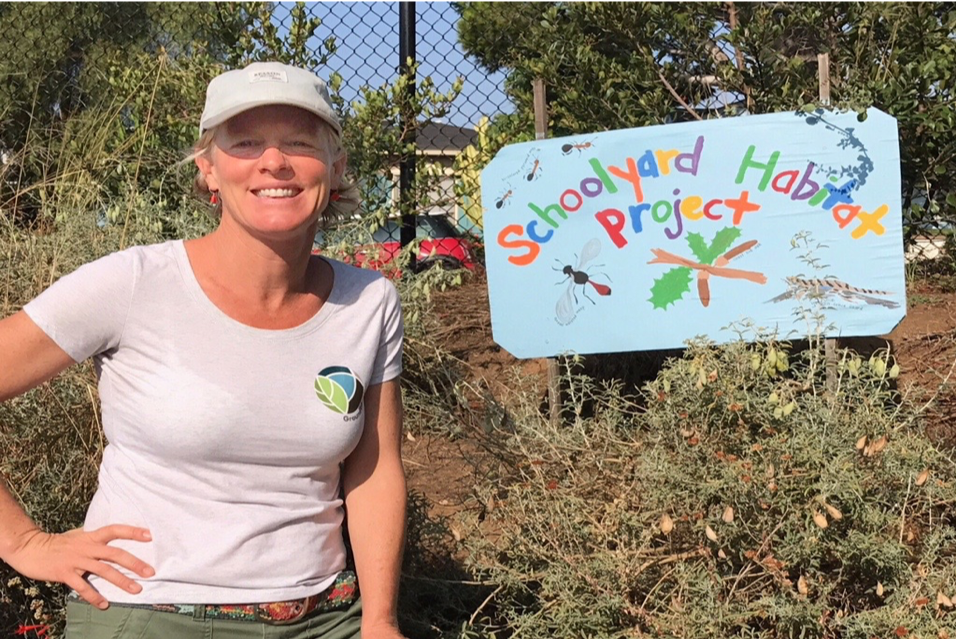
The gardens, nature paths, and play areas, which are constructed by the Ground Education staff alongside the Long Beach Unified School District, provide a gateway to teach environmental literacy and enable students to observe natural phenomena, such as seeing how plants can attract butterflies and birds. Karen credited the greening of 30+ schools to embracing “shared vision and collaborative work; that’s really the key.” Students also learn about the history and the politics of food access in the context of social studies and explore topics related to climate and seasons.
Before reliable irrigation was installed, Karen was known to climb the fences at some schools to water the plants during the summers to ensure students would return to vibrant and welcoming gardens in the fall. Fortunately fence climbing has become unnecessary because the gardens are now visited by professional horticulture staff every week to ensure proper irrigation and safety.
This Eco-STEAM approach encourages students to utilize critical thinking while learning about plant anatomy, decomposition and vermiculture, ecology, pollination, life cycles, food systems, and the important roles of local wildlife in supporting our planet’s well-being. These topics are embedded in cross-curricular lessons that every student participates in during their school year and are a part of the district-approved instructional minutes.
Congratulations to the educators and administrators who have gone the extra mile to develop their students’ understanding of climate change and empower them to think critically about the socio-political issues related to climate justice.
Program Overview
The mission of the California Environmental Education Foundation is to inspire young people to understand and care for the environment through the support of innovative environmental education programs and partnerships.
Each year, CEEF provides a monetary award to recognize one California student, educator, and administrator for their distinguished service and dedication in the form of projects, programs, or initiatives which advance excellence in environmental education.